

What's wrong with modern reality T.V.
And why Jax Taylor leaving "The Valley" won't help it

SPOILERS FOR THE VALLEY, LOVE ISLAND, THE SECRET LIVES OF MORMON WIVES, AND REAL HOUSEWIVES OF NEW YORK
If you’ve ever wondered where influencers and reality stars go to die, watch The Valley. Developed as a spin-off to Vanderpump Rules, the show follows various reality stars and L.A.-types as they navigate “adulting”—trading parties for play dates, one-night-stands for joint bank accounts with their partners, and an apartment in WeHo for a mortgage on a suburban home in the San Fernando Valley (hence the name). It’s supposed to be a show that answers the question millennials posed to society ten or so years ago: how do you have it all—the family, the career, the house, the lifestyle. What results is something far darker than I think anyone anticipated.
In the hour of The Valley’s season two premiere, you’re confronted with the following. First there’s the inner workings of a bitter divorce between Jesse Lally and Michelle Saniei, as both grapple for the upper hand with their 5-year-old daughter caught in the middle. Then you’ve got seeded hints at the drinking problems of Danny Booko, whose moments of over-indulgence lead to him harassing co-stars and transforming him into what fellow cast members dub “Dark Danny.” And, finally, an off-camera fight between estranged spouses, Brittany Cartwright and Jax Taylor, wherein it’s revealed intimate text messages between Cartwright and a friend of Taylor’s sent Taylor into a blind rage in which he flipped over a coffee table that hit Cartwright’s knee, punched the wall, and broke a bar stool. Their 3-year-old son, Cruz, was in the next room.
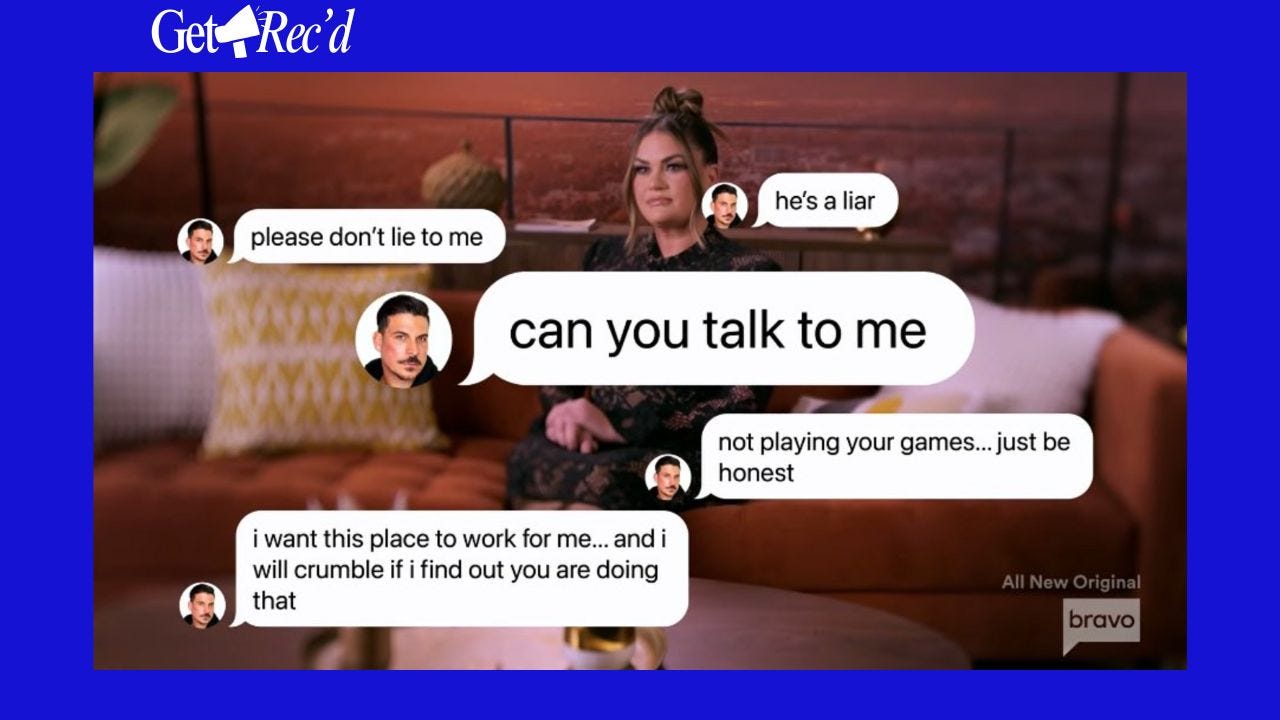
“I lost all control. I saw red. I had an out-of-body experience,” Taylor describes in the show. “But show me a guy that wouldn’t handle the situation the way I handled it.” Future episodes of the show later reveal and explore Taylor’s over-20-year drug addiction, with Taylor checking himself into a mental health facility at the end of the second episode. He stays for 30 days. All the while, he continues to send threatening messages to his estranged wife, Cartwright, who ultimately files for divorce and sole custody while Taylor is away. Taylor does leave the facility and return to the show about mid-way through the season. Last week, Taylor announced he would step away from season 3 of the show.
In a way, the show offers a glimpse into what goes on behind the scenes of the tabloid fodder headlines you see in line at the grocery store—the divorces, the alcohol problems, the custody battles, the stints in rehab—and that’s perhaps the more uncomfortable part of the show. In fact it was that season two premiere of The Valley that made me realize there was something irreparably dark about modern reality television. And once I noticed it with one, I started seeing it everywhere. The Warhol film that was the Real Housewives of New York season finale—wherein a serious accusation regarding a sexual assault was used as a storyline. Watching Jen Affleck’s entire storyline on the most reason season of Secret Lives of Mormon Wives, which includes fighting with her husband, contemplating separation from her husband, discovering she’s pregnant on camera, and battling through severe prenatal depression (in that order). It all felt off, but I persisted—perhaps morbidly—for the sake of some sort of perhaps perverse entertainment.
I won’t sit here and not acknowledge that the schadenfreude of reality T.V. is an integral aspect of the genre. As vaguely depraved as it is when you spell it out, we enjoy watching other people do stupid things—stupid things we would never do as well as stupid things we may have done, but would never tell anyone we have. Lately though, it’s felt a little like most producers and showrunners are engaging in an experiment to see how far they can push that envelope of displaying misfortune to retain audience attention. Some of the time it’s entertaining and engaging. Other times, it feels dangerous. The situation with Jax Taylor on The Valley presents the perfect example of that.
We can certainly look to Vanderpump Rules’ Scandoval Era—described by Variety as an “entrancing intra-cast cheating scandal turned international news story from spring 2023”—as a tipping point. It delivered an electric jolt to a dying franchise by perfectly balancing raw, emotion-packed reactions with a devastating scandal that rocked the foundations of a friend group. Compelling storyline aside, Scandoval was absolute candy for an audience. The lore leading up to the events ran deep. When asked to show their reactions, all cast members came to play. You couldn’t have written it better if you even tried—reality television at its finest.
Perhaps most importantly, the stakes were just high enough—emotionally devastating for all parties involved, but not detrimentally traumatic, physically harmful, or a genuine threat to someone’s well-being. What’s happening right now on The Valley feels much more dire. As Variety puts it in a recent feature about the show, “Taylor’s volatility is partly what made him so skilled as a shit-stirrer and chaos agent on “Vanderpump Rules”—but, when you compare the situation with Taylor with Scandoval, “Taylor’s violent flare-up, and the fallout from it” has played out deeply “unsettling.” Tom Sandoval of the aforementioned Scandoval affair is a terrible person and a compulsive liar, and I would never want any of my friends to date him. But I don’t worry for anyone’s safety watching him on my television. Jax Taylor, on the other hand...
Therein lies the fourth wall of reality television that’s evidently far more tenuous than it should be: Do I worry about the safety and well-being of this person on my screen? That’s the one line of the reality television world that can’t be crossed, the one wall that can never be broken. If the answer’s yes, then something in the social contract between viewer and entertainer has been broken. It’s real, certainly. But at what cost?
People only want to watch reality television and relish in the misfortunes of others when the stakes of the situation are low enough that they can fade until forgotten. The second you bring in the question of someone’s well-being, the stakes rise to a point that becomes unignorable for audience members. It’s not fun, now it’s just sad. What’s worse, the audience becomes aware that maybe they shouldn’t be watching this, which is the absolute last thing you want when your business is in airing the real lives of people.
Jax Taylor leaving The Valley was the right decision. To have him and his story on television right now is irresponsible to everyone—Taylor himself, Cartwright, their son, the cast, the audience. But it was a decision I honestly hadn’t been all too confident would happen. In all honesty, between Taylor’s Watch What Happens Live and various podcast appearances, it seemed Bravo and its affiliates were at least willing to give Taylor alternative platforms to defend himself. Showrunner Alex Baskin even brought Taylor on to his “Bravo’s Hot Mic” podcast in March. It makes me wonder what went into the decision for Taylor to step back. And while we can praise Bravo and the production team behind The Valley for making the right decision—just as we praised them earlier this year for quietly cancelling Real Housewives of New York after the disastrous finale and Peacock for their recent Love Island cast firings—I wonder why we don’t ask them to confront the circumstances that forced their hands to make those decisions in the first place.

I’ve got almost a month’s worth of news updates to get through, so without further adieu…
Anna Wintour to step down as editor-in-chief of American Vogue. She will continue to serve as the global editorial director of all Vogue imprints, and will remain as head of content at Condé Nast. Wintour was one of the last people to hold the position of editor-in-chief in the magazine industry. US Vogue will now have a head of editorial content, a job title more commonly seen in the modern magazine and media industry. In the words of my 21-year-old sister: this feels like a new pope, but for fashion.
I was going to give a Love Island update, but I feel like I’ve lived a million lives in the three weeks since I last wrote about it. Anyways, Beyond the Villa—which follows all of our faves from last season of Love Island USA—premiered July 13.
Dior’s Jonathan Anderson era is everything to me. Remember a few weeks ago, when I posited that Dior named Anderson in the hopes he would bring the luxury design house further into the modern zeitgeist? Judging from what we’re seeing of the summer collection, I’d say mission accomplished.

CBS is cancelling “The Late Show With Stephen Colbert.” The late night talk show will end in May 2026, and I personally haven’t felt this upset by a white man leaving my television since Steve left Blue’s Clues in 2002. The cancellation has sparked a lot of debate around the state of late-night, and if this might signal its imminent demise. The New York Times even went so far as to say it “may end up being the best thing that ever happened to Stephen Colbert.” I’m inclined to agree on both fronts, and look forward to listening to Colbert’s dulcet tones on whatever podcast he inevitably launches.
J. Crew sells pasta now. The clothing brand collaborated with pasta producer Sfolglini to launch a cascatelli, a pasta shape which coincidentally vaguely resembles the letter “j.” Believe it or not, this isn’t the first time a clothing brand has dabbled in food (see the Brandy Melville olive oil). It’s a trend I’ve actually been seeing a lot in the last few years, and I think Andrea Hernández describes it best in her newsletter Snaxshot: Food in the fashion space is the new lipstick economy, the “affordable affluence” that indicates your taste, and this is just its most recent iteration.
